
Laboratory Test Results
Condensate Water
Ever wonder what is in the water that comes out of a dehumidifier? Some might guess heavy metals, but what does a lab test say? Is it safe?
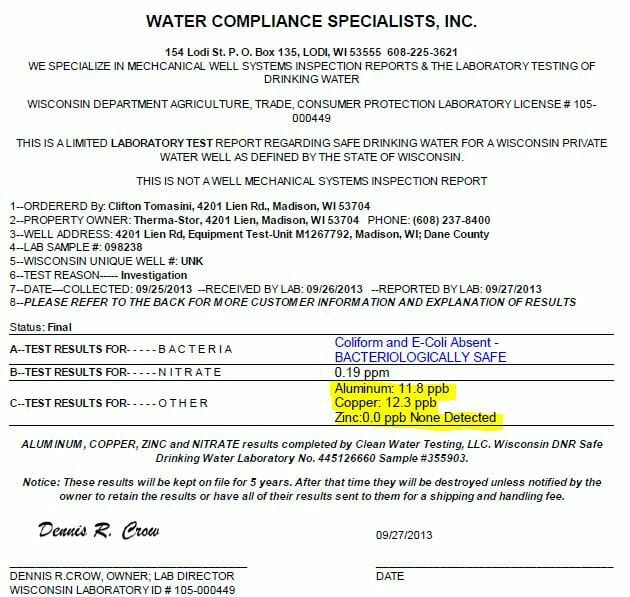
Over the years, we have conducted these tests a few times. This 2013 test was one of those times. I found a dehumidifier that was a few years old and had been running in a basement. After contacting a testing lab, I received a set of clean bottles and filled each set with water from this completely random dehumidifier. The test results for this unit are here:

Notice that the highest level of any metal was about 75 parts per billion (ppb) or 0.075 ppm, a level that is even safe to drink.
After completing this first test and sharing the results with a gardener, I was told that my test was flawed and that a new unit would have a higher level of metals present. Again I contacted the testing lab, gathered the materials, randomly chose a new unit, and sent the samples for analysis. Those results are shown here:

As you can see, the new unit came back with similar results. Again, levels that would be safe to drink.
The story continues in early 2015 when I was working with a commercial aquaponics farmer in Wisconsin. When asked if they would reuse the water from their dehumidifiers with their fish they firmly stated, “NO WAY”. Like many before them they were concerned that the metals from the dehumidifier would leach out and kill the fish. After showing them my prior test results, they still refused to use the water because those dehumidifiers are not the same ones they have. Back to the lab we went… and just to be extra certain we changed labs too. Would the new lab or these different dehumidifiers give us different results?
The results for the dehumidifier condensate from the aquaponics greenhouse are shown here:

Again, only very small amounts of metal could be found. Note that ug/L is equivalent to parts per billion.
The results for the dehumidifier condensate in the aquaponics fish room are shown here:

Like the tests before, leaching heavy metals was not a real concern.
The only caveat with the results from the dehumidifiers from the aquaponics farm was the presence of coliform bacteria. It should be noted that coliform bacteria is naturally present (the constant splashing of the fish) in this environment and not something that originated from the dehumidifier. For this reason, returning the condensate water to the system is not considered a contaminant as it is already present. Though this bacteria likely makes the water unsafe to drink for humans, it is naturally found in soil and thus safe to feed their plants.
Until next time….
2 responses to “Laboratory Test Results: Condensate Water”
-
An absolutely great article! Lab testing gives the answer. Question: if water produced from a typical dehumidifier in a room in a house is to be used for an emergency drinking water supply, do you have any comments regarding the safe production and use of such water that will be used to drink, or even to store in such a time?
I’ve read of others concerns online about the possibility of bacteria from mold, spores, and other such things as well as worries about heavy metals working their way in to the water from the dehumidifier and its associated parts (perhaps the filter too?)
Several articles online also brought up the risk of Legionaire’s disease.
Are there any features, or construction quality/materials used that one would look for when shopping for a room dehumidifier to avoid these concerns? Or perhaps one brand notably better than others? Perhaps some modifications would enhance the safe production of potable water from one’s dehumidifier?
Bottom line question is, can one purchase a standard room dehumidifier at reasonable cost without any unusual or high tech features and produce consistently potable water with no additional steps, filtering, etc needed?
Thanks,
Paul-
Paul, thanks for commenting.
Bacterial growth would be my greatest concern when considering using recycled condensate water as a drinking source. Plant roots and the microenvironment of the root zone act as decontamination filters for any low level bacterial content. This type of water is not an issue-free drinking source. Drinking water should always be treated to prevent contamination and growth of contaminating organisms (usually with chlorine).“Bottom line question of can one purchase a standard room dehumidifier at reasonable cost without any unusual or high tech features and produce consistently potable water with no additional steps, filtering, etc needed?”
My response would be no that this is not possible. One of the reasons is that plants can drink from a mud puddle and we can’t.
-
Leave a Reply