
How Lighting Changes Affect a Grow Room’s Climate Control Strategy
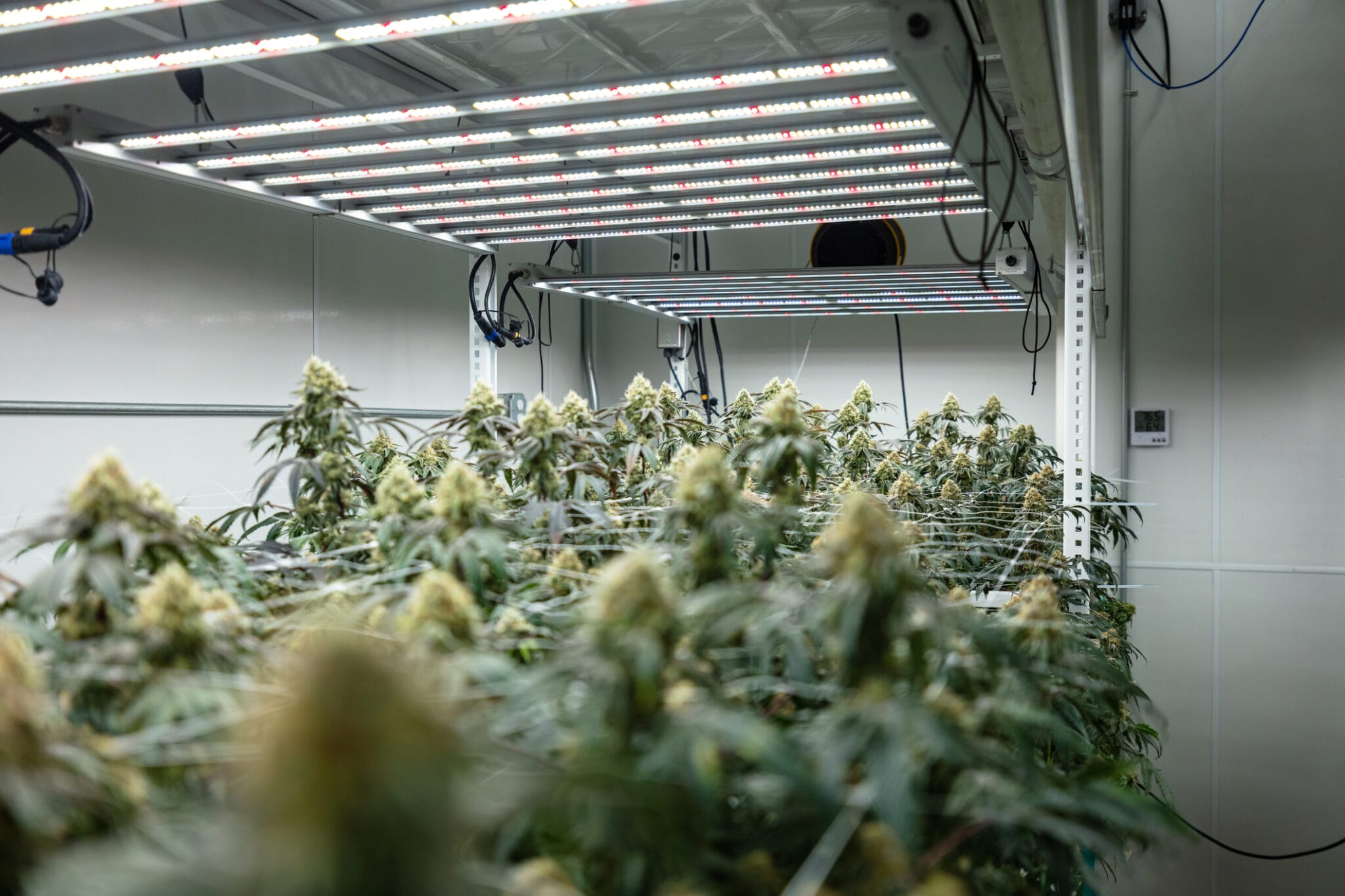
When growers make the switch from high-pressure sodium (HPS) lights to LED lighting, their crops feel the shift. Growers feel it, too. The change affects how plants absorb nutrients, so feeding strategies have to adapt along with climate control.
“The temperature of the room, dehumidification, air conditioning, and CO2 all have to change,” says Randy Lenz, application engineer for Quest. “You make one little change to your facility, and it affects everything else.”
Grow rooms that use HPS lights typically run warmer because of the heat the fixtures give off. Lenz compares them to heat lamps: hung above the plants, they beat down on the canopy and heat up the plants.
“You have to be careful about how close those lights get to the plants and make sure you’re cooling the room,” he explains. “This is not only to get rid of the heat from the lights, but to cool the plants, too. Otherwise, they would get way too hot.”
The heat from LED lighting, by contrast, is felt on the back end. It doesn’t beat down on the plants, so rooms can run warmer than they did under HPS lights. Since plants prefer warmer temperatures, growers have to adjust the room climate to keep their crops happy.
Planning for Climate Control Changes
Before upgrading their lighting, growers should consider the size of their grow room, the crops they’re growing, and the equipment they already have. One thing is certain: after the switch from HPS to LED, they’ll have more air conditioning capacity than they need. That means planning for how the AC will run.
“You need to plan for that,” Lenz adds. “You’re going to want to keep the AC running steady instead of cycling it on and off repeatedly.”
Growers should also reevaluate their dehumidification load. Air conditioning removes moisture as it cools, so with less AC running, some of that work now falls to the dehumidifiers. Lenz encourages growers to compare their current water feed—the water going to the plants, which ends up in the room’s air as humidity—to what it was when the grow room was originally designed. If they’re only upgrading the lighting instead of starting from scratch, a lot has probably changed.
“Reevaluate your water feed and what your dehumidification needs are,” he urges. “Talk to somebody like myself to help you evaluate if you have enough dehumidification to make up for what the air conditioning isn’t removing anymore.”
Signs a New Lighting Setup Is Struggling
Major swings in temperature and relative humidity (RH) are a sign something is off. Because LEDs cut the cooling load, air conditioning that operated consistently may now switch on and off too often. The fix often goes beyond the lighting itself and comes down to how the equipment is staged.
“If you see a lot of temperature swings during the day, your AC is likely oversized and turning on and off too rapidly,” Lenz explains. “Beyond lighting, we talk to customers all the time about staging. If you stage your equipment properly, bringing units on and off as needed, you’ll get a much steadier temperature and humidity level.”
For context, staging means that multiple smaller-capacity units work together to adjust dehumidification output as conditions change. This gives cultivators greater control, flexibility, and reliability than a single large-capacity dehumidifier can provide.
Humidity swings aren’t always an equipment problem, though. Poor airflow can cause the same instability, and many rooms don’t have good air movement to begin with. Multi-tiered rooms are especially prone to it, since racking blocks much of the flow. Changing the lighting won’t fix it because lighting doesn’t affect airflow.
Fans are what fix it. Left alone, humidity tends to stratify in a room, and poor air movement can aggravate the issue. When circulating fans mix the air well, dehumidifier placement matters much less.
Who’s Involved in the Lighting Upgrade Conversation?
More people should be involved in the lighting upgrade conversation than the grower and a lighting supplier. HVAC and dehumidification companies should have a seat at the table as well.
“You can’t just install LEDs and hope for the best,” Lenz says. “You’ve got to take a big picture look at how it impacts the entire system.”
Part of the challenge is that growers can be slow to make all the necessary adjustments to their rooms with the new lights.
“Some people are reluctant to change room temperatures and humidity levels,” he explains. “They put the lights in, and their plant doesn’t respond how they expected it to. Everything needs to change: temperature, humidity, water feed, everything.”
The Real Work Is Everything Around the Lights
That’s Lenz’s biggest piece of advice for growers: make sure the equipment is sized for the new load and know how to control it, because the load is different after upgrading their lighting.
An LED upgrade shifts the heat load, the moisture load, and the way the whole room behaves. Air conditioning that was sized for HPS may be bigger than the room needs, and the dehumidifiers may have to pick up work the AC used to do. Left unchecked, that shows up as swings in temperature and humidity, and in plants that don’t respond the way the grower expects.
The fix starts with planning.
- Stage the equipment so units come on and off gradually instead of all at once.
- Check that the air is mixing well enough to hold steady conditions from corner to corner.
- Revisit the water feed and the dehumidification load.
- Bring HVAC and dehumidification experts in early, before the fixtures go up, rather than after the room starts to struggle.
Growers who treat an LED upgrade as a lighting project alone will spend their first months chasing problems. Those who treat it as a whole-room project will have the room ready on day one.
Published on Nov 17 2026
Categories: Climate Control
Tags: climate control, dehumidification, energy efficiency, lighting
